For businesses trying to increase online visibility, AEO vs SEO comes down to one practical question: should you optimize for Google rankings, AI-generated answers, or both?
Search engine optimization has mostly meant earning ranking positions on Google for more than two decades.
But in 2026, search is no longer limited to the traditional SERPs.
People now ask questions inside AI search tools like ChatGPT, Google AI Overviews, and Perplexity, where visibility often depends on whether your brand is cited, summarized, or recommended as part of the answer.
That shift is the easiest way to understand the AEO vs SEO meaning: SEO helps your content rank in search results, while AEO helps your content become the answer AI engines choose to summarize, cite, or recommend.
In this beginner guide, you’ll learn all about AEO vs SEO, including what AEO and SEO are, the key differences between them, where they overlap, and how to use both in your 2026 content strategy.
Answer engine optimization, or AEO, is the process of optimizing content so AI search engines like ChatGPT, Perplexity, Google AI Overviews, Gemini, and Claude, as well as voice assistants like Alexa and Siri, can understand it and use it in direct answers.
As such, AEO focuses on ensuring your brand will appear in conversational queries, AI-generated responses, zero-click search experiences, and citations.
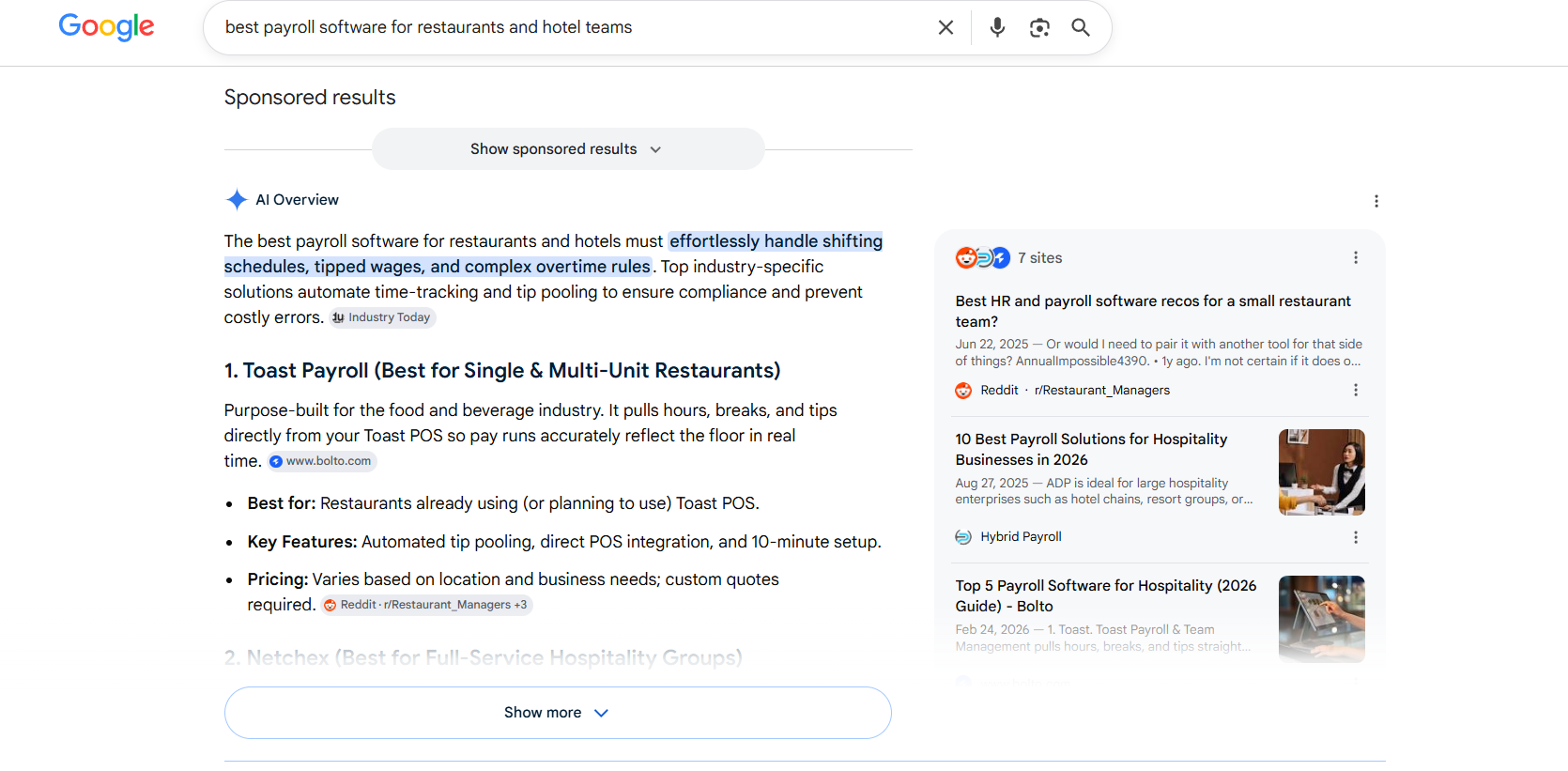
For example, if your company provides payroll software for hospitality businesses, AEO is what helps your brand appear when someone asks ChatGPT, “What’s the best payroll software for restaurants and hotel teams?”
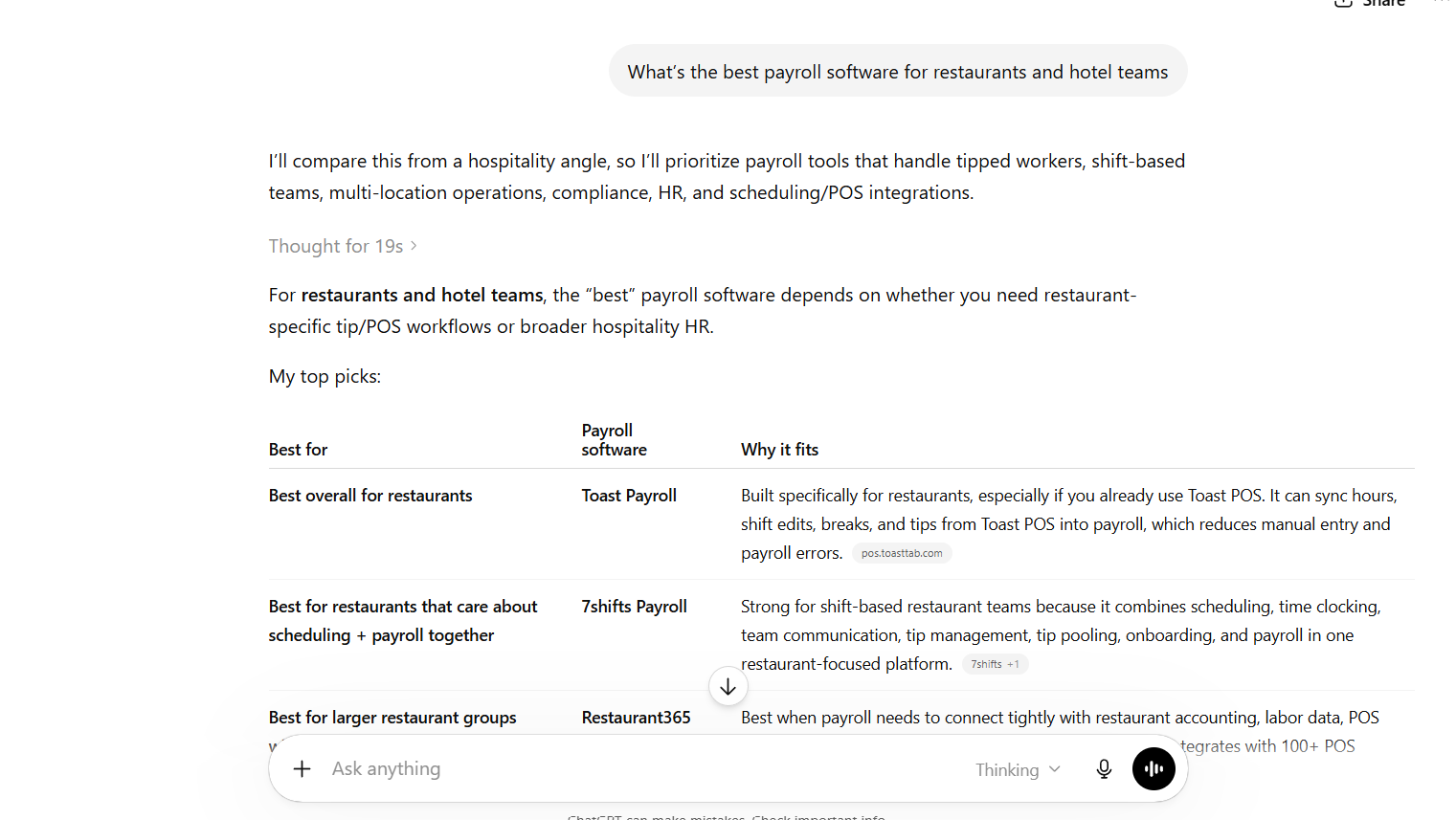
Here, you are not only competing for a ranking position. You are competing to become part of the answer itself.
The best way to get a full grasp of AEO is by comparing it to SEO, so let’s get into some more detail below.
So, as mentioned above, in the AEO vs SEO conversation, AEO is best understood as a digital marketing strategy for making your content easier for answer engines to find, interpret, reference, and cite.
The goal is simple: when someone asks an AI tool a question related to your business, your brand should have a better chance of appearing in the answer.
This matters because search behavior is shifting toward conversational questions and answer-first experiences.
According to McKinsey, 44% of users prefer AI-powered search to traditional search engines, while Adobe found that a staggering 77% of U.S. ChatGPT users use it primarily like a search engine.
And while this might look like the AEO vs SEO debate is about replacing SEO, it is actually about extending it.
AEO builds on top of SEO because answer engines still need trustworthy, well-structured, publicly available information to work with.
If your content is thin, unclear, hard to crawl, or disconnected from your brand’s wider authority, AI systems have fewer reasons to use it in a response.
But if your pages already answer real search intent, explain topics clearly, show expertise, and earn credibility across the web - which is all SEO - they become easier for both search engines and answer engines to understand.
From there, AEO adds another layer. It makes the answer easier to extract by using even clearer formatting, structured data, schema markup, concise definitions, direct responses, and stronger entity signals.
So, when people ask what is AEO vs SEO, the simplest answer is this: SEO helps you rank where people search, while AEO helps you get cited where people ask.
Search engine optimization, or SEO, is the practice of improving a website’s organic visibility in traditional search engines like Google and Bing by helping pages:
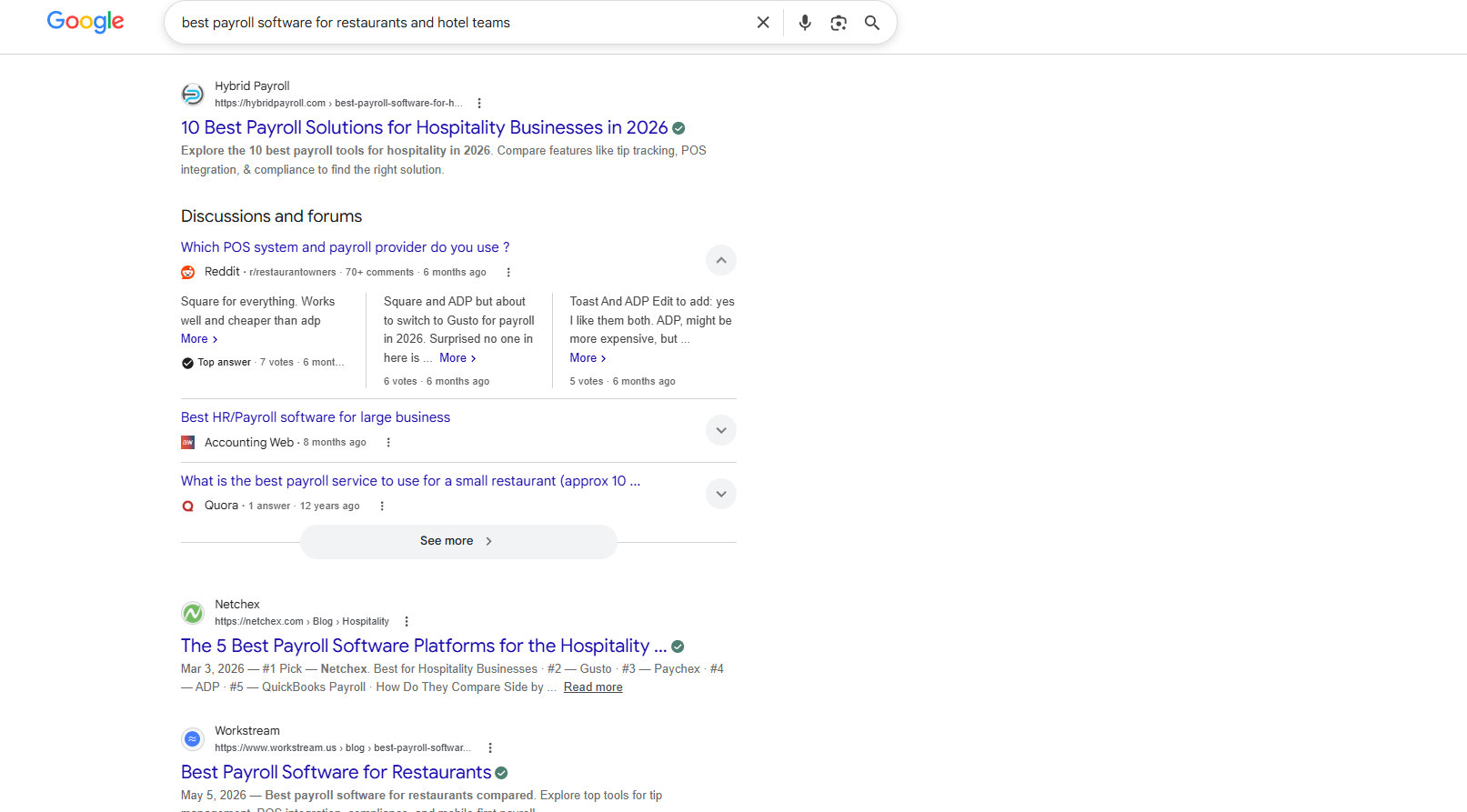
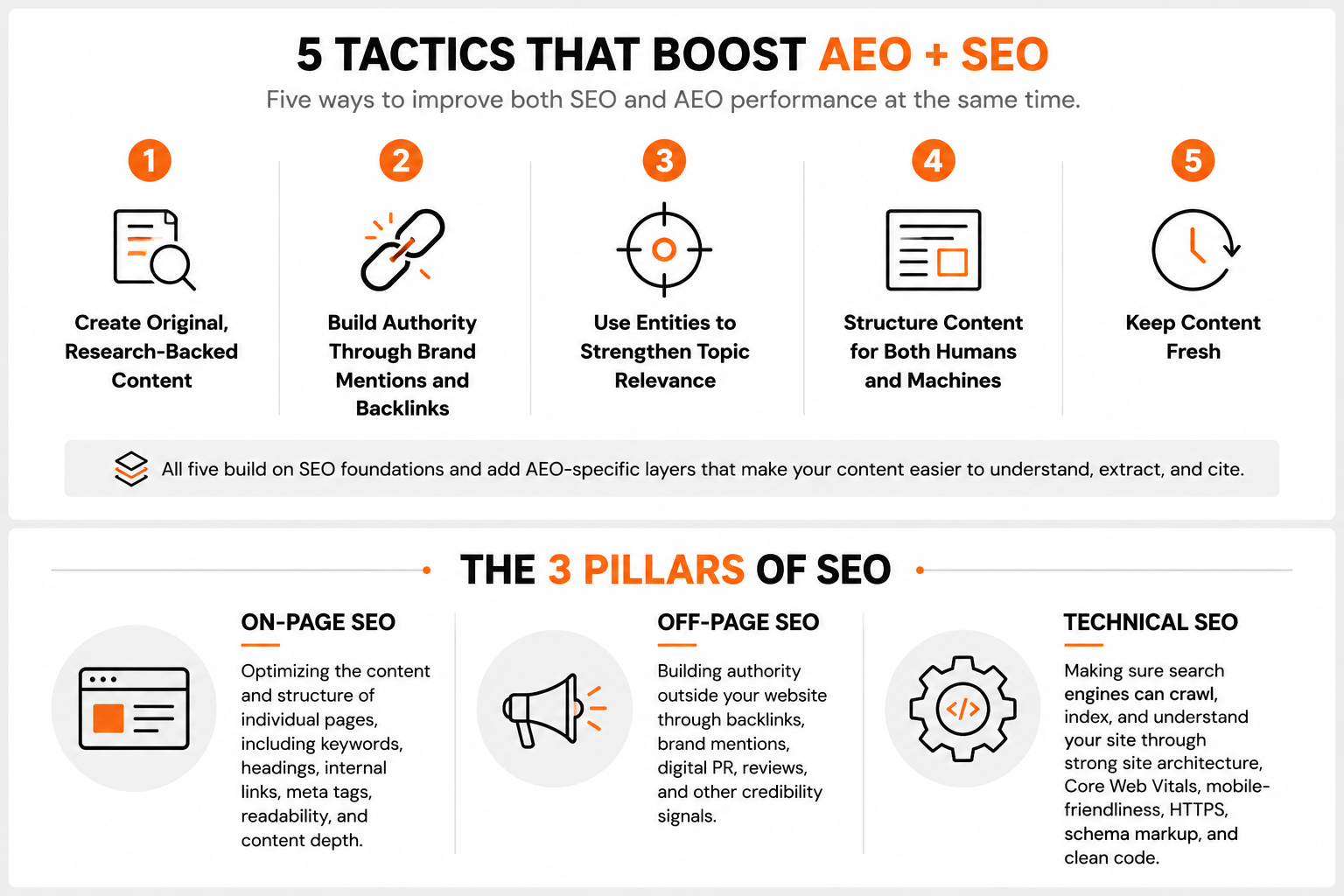
Most SEO work falls into three core pillars:
Traditionally, the main goal of SEO is to rank on search engine results pages and bring qualified visitors to your website. That can support every stage of the funnel, from early education to product comparison and purchase decisions.
However, SEO is no longer only about classic blue links. Modern search results now include featured snippets, AI Overviews, knowledge panels, People Also Ask boxes, local packs, videos, and other SERP features.
That is why SEO vs AEO is not an either-or question. Instead, they support each other in two important ways:
AEO and SEO share the same DNA: high-quality, authoritative content.
But the difference between AEO and SEO comes down to where and how your content shows up:
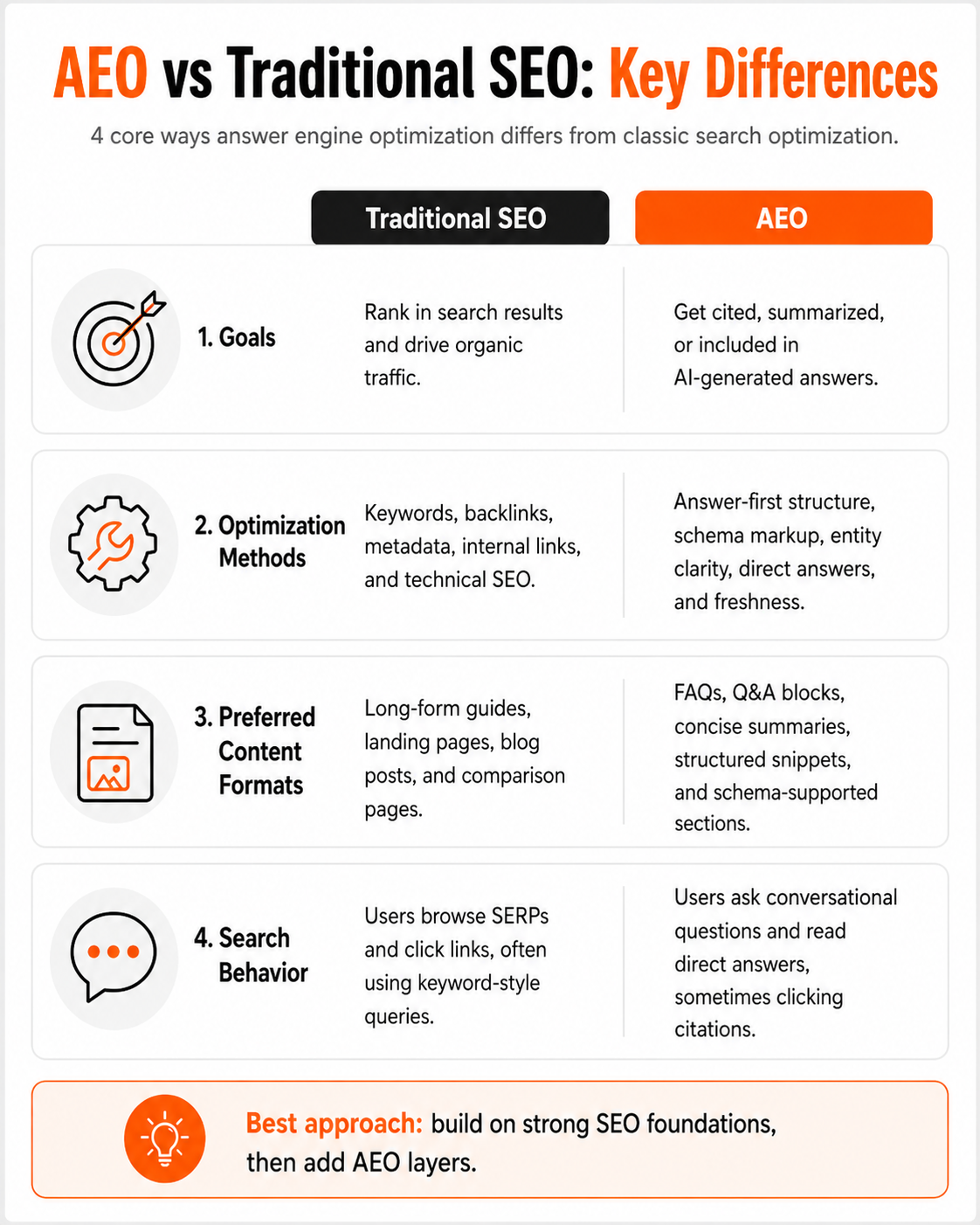
The table below gives a clear overview of the key AEO vs SEO differences:
The key thing to keep in mind when comparing AEO vs SEO is that they optimize for different search experiences.
As a result, we can identify four main AEO vs traditional SEO differences:
The difference SEO and AEO create in execution does not mean they are separate strategies. In practice, they overlap heavily:
In other words, while the AEO vs traditional SEO differences do exist and matter, they do not erase the fundamentals: AEO builds on the same credibility signals that have long helped SEO work.
No, AEO is not replacing SEO.
It is an evolution of search optimization built for AI search in 2026, and both AEO and SEO work best as complementary strategies.
So, are SEO and AEO different? The answer is both yes and no.
They are different in their targets and tactics, but similar in their underlying principles:
This is why the biggest mistake in the AEO versus SEO debate is treating the two as competing channels, as that argument completely misses how AI systems choose sources.
Semrush research found that domains with stronger authority signals, especially quality backlinks and higher Authority Scores, were more likely to appear in AI-generated answers, meaning that good SEO directly impacts AEO results.
So, SEO is still the foundation that makes your content discoverable, crawlable, and credible, while AEO is the layer that makes that content easier for AI systems to understand, extract, and use in direct answers.
Put another way, AEO is less of a replacement for SEO and more of a practical upgrade for the new era of online search.
Therefore, the takeaway is simple: marketers should not choose between SEO and AEO. In 2026, the best approach is hybrid.
AEO and SEO work best as an integrated strategy where SEO helps your content become discoverable and AEO helps that content become usable in AI search experiences.
Together, they improve overall brand visibility and share of voice across trusted domains.
When you treat AEO and SEO as one stack, their relationship becomes much clearer.
SEO builds the foundation. As Semrush research showed, strong technical SEO, helpful content, backlinks, internal links, and topical authority make your website easier for search engines to crawl, index, and trust.
And AEO makes that foundation more citeable, as organic rankings are only part of the picture.
Semrush found that AI citations only partially overlap with Google’s top 10 results, and that the level of overlap varies by platform.
Perplexity showed the strongest alignment with Google rankings, Google AI Overviews also showed significant overlap, Google AI Mode had a looser connection, and ChatGPT showed the weakest overlap with Google’s top 10.
This means that investing in SEO can indirectly raise your AEO visibility, but only if your content is also structured for AI extraction.
So, AEO is all about ensuring there are clear definitions, structured data, schema markup, concise answers, FAQs, and other factors that help AI tools understand what your page is about and when to reference it.
Next, we’ll explore some of the best strategies that can help you efficiently implement both AEO and SEO.
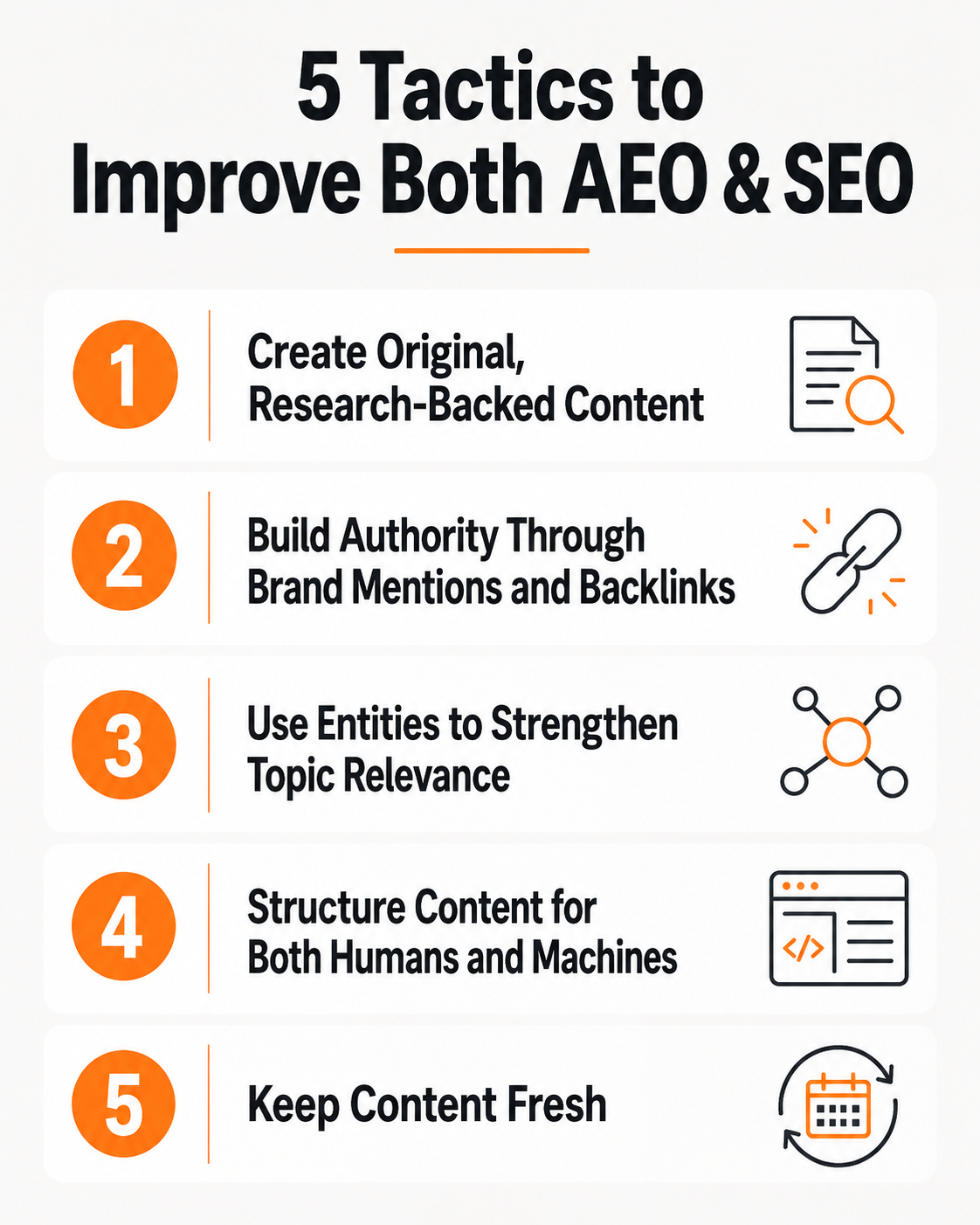
The smartest approach is to treat AEO and SEO as one connected workflow, not two separate strategies.
The five tactics below are designed to improve both at the same time.
Each one starts with a strong SEO foundation, then adds an AEO layer that makes your content easier for AI systems to understand, extract, and cite.
Original content is one of the strongest ways to improve both SEO and AEO because it gives search engines and AI systems something worth referencing.
Google’s guidance on helpful content encourages creators to provide original information, reporting, research, or analysis instead of simply rewriting what already exists.
That same logic applies to AEO: if your content includes insights that are specific, verifiable, and hard to find elsewhere, it becomes more useful as a source for AI-generated answers.
This doesn’t mean you need a large research study for every article. Smaller signals of originality work too, such as:
Backlinks still matter for SEO because they help search engines understand which pages and domains are trusted by others.
But quality matters more than volume. A few relevant links from respected industry sites are stronger than dozens of weak links from unrelated domains.
For AEO, authority extends beyond traditional backlinks, as AI systems may use unlinked brand mentions in industry publications, YouTube videos, Reddit threads, comparison pages, podcasts, and third-party articles to understand what your company is known for and whether it should be included in an answer.
To build this authority, focus on:
Entities are clearly identifiable things, such as people, companies, products, places, concepts, and industries.
Google uses entity-based understanding through systems like the Knowledge Graph, which helps it connect facts about people, places, and things.
AI systems also rely on entity recognition and context to understand what a piece of content is about.
For SEO and AEO, this means your key entities should be clear and consistent.
You can do this by using the same terminology throughout the article, connecting your brand or product to the problem it solves to avoid ambiguity, and including related subtopics that define the broader context.
For example, if you are writing about Google AI Overviews, avoid switching between “Google AI Overviews,” “AIOs,” and “AI summaries.”
This kind of consistency makes the topic easier to understand, connect, and cite.
Well-structured content is easier for readers to scan and easier for search engines and AI systems to interpret.
This means that for SEO and AEO, structure is not just a formatting choice. It helps clarify what each section answers, how ideas connect, and which parts of the page are most useful for extraction.
The goal is simple: make every page easy to read, easy to crawl, and easy to cite.
Here’s how you can do this:
Before publishing, make sure to validate your markup with Google’s Rich Results Test to catch errors and confirm which rich result types your page may be eligible for.
Freshness matters for both SEO and AEO, especially on topics where information changes quickly.
Outdated statistics, old screenshots, retired tools, stale pricing, or irrelevant examples make content less useful to readers and less reliable as a source for AI-generated answers.
So, for practical content maintenance, make sure to regularly update:
For high-value pages like comparison articles, software roundups, pricing guides, and “best tools” lists, a quarterly audit is a smart cadence.
For slower-moving evergreen content, semi-annual or annual reviews may be enough.
And remember, the goal is not to update content just to make it look new. The goal is to keep every important page accurate, current, and useful enough to earn rankings, citations, and trust.
The main difference between AEO and SEO is where your content appears. SEO helps your pages rank in traditional search results, while AEO helps your content get cited, summarized, or referenced in AI-generated answers.
SEO focuses on organic rankings, traffic, backlinks, technical SEO, and on-page optimization. AEO focuses more on answer clarity, structured content, entity relevance, schema markup, and citation worthiness.
No, AEO is not replacing SEO. AEO is an evolution of SEO built for AI search, but it still depends on many SEO fundamentals.
Strong SEO helps search engines and AI systems discover, crawl, and trust your content. AEO adds another layer by making that content easier to extract, summarize, and cite.
Yes, most businesses need both AEO and SEO in 2026.
SEO helps you stay visible in Google and other traditional search engines, while AEO helps you show up in AI search experiences like ChatGPT, Perplexity, Google AI Overviews, Gemini, and Microsoft Copilot.
To optimize content for AEO, write clear answers to specific questions, use structured headings, add schema markup where relevant, and make key entities easy to understand.
You should also support claims with credible sources, include original insights, keep content updated, and build authority through backlinks, brand mentions, and expert commentary.
Yes, SEO can help with AI visibility because AI search systems often rely on trusted, authoritative, well-structured content.
Pages with strong topical relevance, helpful information, clean structure, backlinks, and credible brand signals are more likely to be understood and considered by both search engines and AI systems.
The best way to start with AEO is to audit one important page and make it easier to answer, extract, and cite.
Start by adding direct answers under key headings, improving structure, updating sources, clarifying entities, adding relevant schema, and making sure the page gives readers information they cannot get from a generic summary.
AEO vs SEO is not a choice between old search and new search.
SEO helps your content rank where people search. AEO helps that same content get cited where people ask.
In other words, SEO and AEO support the same larger goal: stronger search visibility across levels.
So, the best 2026 strategy is to treat them as one connected system.
And while the tools and terminology will keep changing, the principles will stay the same: be useful, be clear, be trustworthy, and keep your content current.
You can start optimizing your content for both traditional and AI search right now: just choose one high-value page and audit it against the five tactics above.
Or, if you want an immediate breakdown of where your brand stands today, get our free AEO report to see how visible your content is across AI search.